
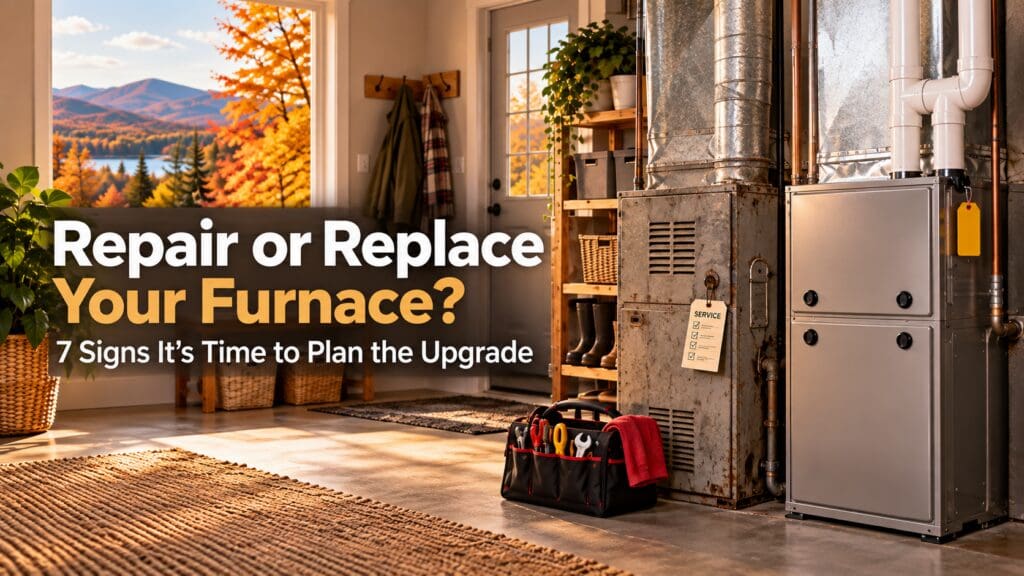
When a furnace stops working, the first question is usually simple: Can it be repaired?
The better question is sometimes: Should it be repaired?
For homeowners in Upstate New York, that distinction matters. Our heating systems work hard for a significant part of the year, and putting another major repair into an aging furnace does not always make financial sense.
That does not mean every older furnace needs to be replaced. A well-maintained system can provide reliable service for many years. But there comes a point when repeated repairs, declining performance and rising operating costs start making replacement the better long-term decision.
Here are seven signs it may be time to start planning a furnace upgrade rather than waiting for the next breakdown.
Repair vs. Replace: There Is No Single Answer
There is no universal age or repair cost that automatically means a furnace needs to be replaced.
The right decision depends on several factors:
- Age and overall condition of the furnace
- Repair history
- Cost of the current repair
- Availability of replacement parts
- Heating performance
- Energy usage
- How long you plan to stay in the home
- Whether other HVAC equipment is also approaching replacement age
A relatively minor repair on an otherwise dependable furnace can absolutely make sense.
But if you’re facing a significant repair on a system that has already given you several warning signs, it may be worth putting that money toward new equipment instead.
1. Your Furnace Is Approaching 15–20 Years Old
Age alone does not determine when a furnace needs replacement, but it is one of the most important factors to consider.
Many furnaces can operate for 15 years or longer when properly installed and maintained. As equipment gets older, however, components naturally begin to wear and the likelihood of repairs tends to increase.
If your furnace is approaching the 15- to 20-year range, start thinking beyond the immediate repair.
Ask yourself:
- Has the furnace required other repairs recently?
- Is it still heating the house evenly?
- Have heating costs increased?
- Are replacement parts becoming difficult or expensive to obtain?
- Would another large repair simply delay an inevitable replacement?
You do not necessarily need to replace a functioning 15-year-old furnace tomorrow.
But it is a good time to start planning so you are not forced to make a major HVAC decision during a January no-heat emergency.
2. You Are Paying for Repairs More Frequently
One furnace repair does not mean you need a new furnace.
Several repairs over a short period are a different story.
As equipment ages, homeowners can sometimes find themselves replacing one component only to have something else fail a few months later. Individually, each repair may seem reasonable. Collectively, the costs begin adding up.
Pay attention to the pattern.
If you’ve called for furnace repair multiple times during the past couple of heating seasons, ask your technician for an assessment of the overall condition of the equipment, not just the component that failed today.
A repair may get the system running again. That does not necessarily mean the rest of the furnace is in good condition.
At some point, repeated repairs can become money that would be better invested in newer equipment.
3. Your Heating Costs Keep Increasing
Higher heating bills do not automatically mean your furnace is failing.
Fuel prices, thermostat settings, weather and changes in household usage can all affect what you pay to heat your home.
But if your heating costs are consistently climbing and there is no obvious explanation, the furnace should be evaluated.
Aging equipment can lose performance as components wear, airflow problems develop or the system operates for longer periods to maintain the desired temperature.
A professional inspection can help determine whether the problem is related to:
- The furnace itself
- Dirty or restricted airflow
- Ductwork
- Thermostat operation
- Building insulation or air leakage
- Maintenance issues
- Another part of the HVAC system
If the furnace is older and requires increasingly more energy to keep the home comfortable, replacement may become part of the conversation.
4. Your Home Is Becoming Harder to Heat Comfortably
Your furnace should not just turn on. It should keep your home reasonably comfortable.
One of the more noticeable signs of declining HVAC performance is when the system seems to be running normally but the house does not feel the way it used to.
You might notice:
- Some rooms staying noticeably colder than others
- The furnace running for unusually long periods
- Frequent cycling on and off
- Weak airflow from registers
- Difficulty reaching the thermostat setting
- Larger temperature swings throughout the day
Not every comfort problem means the furnace needs replacement. Ductwork, filters, thermostats and airflow issues can cause similar symptoms.
That is why diagnosis matters.
But when an aging furnace is struggling to maintain comfort despite being properly maintained, replacement may offer a better long-term solution than continuing to work around declining performance.
5. The Furnace Needs a Major, Expensive Repair
This is often where the repair-versus-replace decision becomes most important.
Replacing a relatively inexpensive component on a healthy system is one thing.
Putting a major repair into a furnace that is already near the end of its expected service life is another.
Examples of more significant problems can include issues involving:
- Heat exchangers
- Blower motors or assemblies
- Control boards
- Inducer assemblies
- Major electrical components
- Multiple failed components at the same time
The specific repair cost will vary significantly depending on the furnace and the problem.
Instead of relying on a simple rule such as “replace it if the repair costs more than X dollars,” look at the repair cost in the context of the furnace’s age and condition.
A large repair on a five-year-old furnace may make perfect sense.
The same repair on an 18-year-old furnace with a history of other problems deserves a much closer look.
6. The Furnace Is Showing Signs of Declining Reliability
A furnace does not always go from “working perfectly” to “completely broken.”
Often there is a period where the system becomes increasingly unpredictable.
Warning signs can include:
- Intermittent startup problems
- Frequent resetting
- Unusual rattling, banging or squealing
- New or persistent odors
- Longer heating cycles
- Short cycling
- Unexpected shutdowns
- Increasing service calls
These symptoms should be inspected by a qualified HVAC technician.
Some may be caused by straightforward repairable problems. Others can indicate that multiple components are beginning to wear.
Reliability matters especially in Upstate New York.
A furnace that is “probably going to make it through another winter” feels very different when the overnight temperature drops into the single digits.
Planning ahead gives you considerably more control than replacing equipment during an emergency.
7. You Are Already Planning Other HVAC Upgrades
Sometimes furnace replacement makes sense even before the furnace completely fails.
If your air conditioner, heat pump or other HVAC equipment is also nearing replacement age, it may be worth evaluating the entire heating and cooling system together.
Modern HVAC equipment is designed around specific airflow, controls and operating requirements. Replacing equipment strategically can sometimes create opportunities to improve:
- Heating efficiency
- Cooling efficiency
- Airflow
- Humidity control
- Indoor comfort
- Thermostat capabilities
- System reliability
It also gives you time to compare equipment options rather than simply installing whatever can be obtained quickly during an emergency.
For homeowners considering a larger renovation, addition or comfort upgrade, it may also be an opportunity to determine whether the existing furnace is still properly sized for the home.
When Does Furnace Repair Still Make Sense?
There are plenty of situations where repairing your existing furnace is the right choice.
Repair may make sense when:
- The furnace is relatively young
- The overall equipment condition is good
- The repair is minor
- The system has been reliable
- Heating performance remains strong
- Replacement parts are readily available
- There are no significant safety concerns
The objective should not be to replace equipment simply because it has a few years on it.
The goal is to understand what you’re putting money into.
At Appolo Heating, our technicians can evaluate the immediate problem along with the overall condition of the heating system. If repair is the sensible option, we can explain what needs to be addressed. If the furnace is reaching the point where replacement deserves consideration, we can walk you through those options as well.
Why Planning Furnace Replacement Early Matters
Nobody wants to buy a furnace unexpectedly.
Unfortunately, that is exactly what happens when homeowners wait until an aging system completely stops working.
Planning ahead gives you time to:
- Understand equipment options
- Compare efficiency levels
- Establish a budget
- Discuss financing options
- Determine whether other HVAC equipment should be addressed
- Schedule installation before the coldest weather
- Avoid making a major purchase under emergency conditions
That can be particularly valuable in Upstate New York, where a furnace failure during a cold stretch can quickly become more than an inconvenience.
If your furnace is showing several of the signs above, you do not necessarily need to replace it immediately.
You should, however, know what your next move will be.
Should You Repair or Replace Your Furnace?
A good furnace replacement decision is rarely based on one number.
Think about the entire picture:
A younger furnace + minor repair + good overall condition:
Repair will usually make sense.
An older furnace + expensive repair + several recent problems:
It may be time to seriously consider replacement.
An older furnace that still works but is becoming less reliable:
Start planning now rather than waiting for an emergency.
The important thing is getting an accurate assessment of the equipment so you can make the decision based on your home’s needs and your budget.
Let Appolo Help You Plan Before the Next Cold Snap
Upstate New York winters put heating equipment to the test. If your furnace is getting older, requiring more repairs or struggling to keep your home comfortable, now is the time to understand your options.
Appolo Heating has served New York homeowners since 1968, with technicians serving the Capital Region, Hudson Valley and Southern Tier.
Whether your furnace needs a straightforward repair or you’re beginning to consider a replacement, we’ll evaluate the system, explain what we find and help you determine the most practical next step.
Don’t wait for a no-heat call in the middle of winter to start planning.
Contact Appolo Heating to schedule furnace service or request a replacement estimate.