
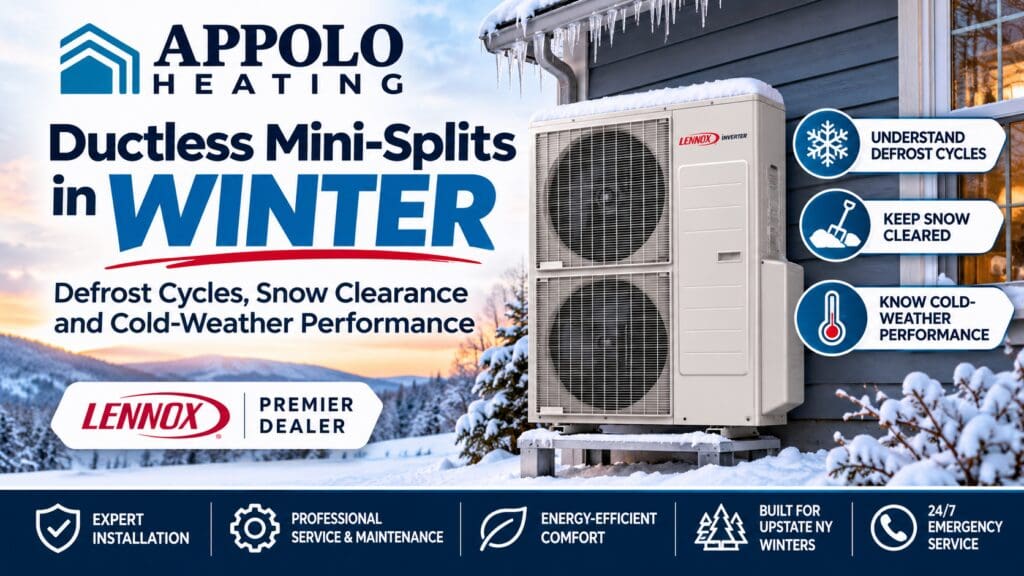
It’s 25°F outside, your ductless mini-split has been keeping the room comfortable all morning, and then something strange happens.
The indoor unit seems to stop heating.
The outdoor fan pauses.
A few minutes later, you look outside and see what appears to be steam coming off the outdoor unit.
For a lot of homeowners, the first thought is:
Something is wrong.
Most of the time, nothing is wrong at all.
You’ve just seen your mini-split go through a defrost cycle—one of the normal ways a cold-climate heat pump keeps itself operating through an Upstate New York winter.
Modern cold-climate ductless systems have changed dramatically from the heat pumps many homeowners remember from decades ago. NYS Clean Heat says today’s cold-climate air-source heat pumps can provide heating even in the coldest areas of Upstate New York, while recent NYSERDA field research found properly designed systems maintaining indoor temperatures through severe New York cold snaps.
But cold-weather performance still depends on three things:
The right equipment. The right installation. And the right winter care.
Here’s what Upstate New York homeowners should know.
Yes, a Ductless Mini-Split Can Heat During an Upstate New York Winter
Let’s start with the biggest misconception.
A ductless mini-split does not need warm outdoor air to produce heat.
In heating mode, the outdoor unit absorbs thermal energy from the outside air and transfers it inside through refrigerant. Even air that feels extremely cold to us still contains usable heat.
What does change as the temperature drops is how difficult that job becomes.
That’s why there is an important distinction between a standard mini-split and a cold-climate mini-split designed for Northeast winters.
NYS Clean Heat recommends choosing equipment specifically rated for cold climates and notes that qualifying cold-climate systems are evaluated for low-temperature operation through the Northeast Energy Efficiency Partnerships cold-climate product criteria.
For Upstate New York, that distinction matters.
Appolo installs and services cold-climate ductless systems throughout the Capital Region, Southern Tier and Hudson Valley, where winter conditions are very different from those in a mild-weather market.
What Happens to a Mini-Split as the Temperature Drops?
A heat pump’s heating capacity and efficiency can change with outdoor temperature.
That doesn’t mean it simply stops working once the thermometer hits 32°F.
Modern variable-capacity cold-climate systems are engineered specifically to continue operating at much lower temperatures.
For example, the current Lennox MWLD single-zone cold-climate mini-split is rated to maintain 100% heating capacity at 5°F and continue operating at temperatures as low as -22°F. It offers efficiencies up to 25 SEER2 and 11 HSPF2.
For homes that need several ductless zones, Lennox’s MMLD multi-zone cold-climate system is rated to maintain full heating capacity at 5°F and operate down to -13°F.
Those numbers don’t mean every home will automatically stay comfortable at those temperatures.
The system still needs to be sized around the home’s actual winter heating load.
That’s why Appolo emphasizes load calculations and proper equipment selection rather than simply choosing a mini-split based on room square footage.
What Is a Mini-Split Defrost Cycle?
Here’s where winter operation gets interesting.
When a mini-split is heating your home, the outdoor coil becomes colder than the surrounding outdoor air.
Moisture in the air can condense on that cold coil.
When conditions are right, that moisture freezes.
A light layer of frost isn’t unusual. But if the frost kept building, it would eventually restrict airflow through the coil and make it harder for the heat pump to absorb heat.
So the system periodically removes it.
That’s the defrost cycle.
During defrost, the heat pump temporarily changes refrigerant flow so that heat reaches the outdoor coil and melts the accumulated frost. Once the coil is clear, the system automatically returns to normal heating operation.
You generally don’t need to do anything.
Why Does My Mini-Split Stop Blowing Heat During Defrost?
Because the system is temporarily concentrating on clearing the outdoor coil.
Depending on the system, you may notice:
- The indoor fan slows or stops
- Warm airflow pauses briefly
- The outdoor fan stops
- The compressor sounds different
- A swooshing or refrigerant-flow sound occurs
- Water begins draining beneath the outdoor unit
- A cloud of white vapor or steam appears
Those can all be normal parts of defrost operation.
The steam often concerns homeowners the most.
Remember: the system has just heated an icy outdoor coil. Meltwater and cold outdoor air can create a visible cloud of vapor.
Steam coming from a heat pump during defrost does not automatically mean the equipment is overheating or smoking.
Industry guidance identifies that temporary steam plume, changing operating sounds and a stopped outdoor fan as normal signs of a defrost cycle.
Why Does Defrost Sometimes Happen When It Isn’t That Cold?
Because temperature isn’t the only factor.
Moisture matters.
In fact, frost conditions can sometimes be worse during a damp 30°F day than during a very dry 5°F night.
The outdoor coil itself may operate substantially colder than the outdoor air while extracting heat. That means frost can form even when the outdoor air temperature is slightly above freezing.
That is particularly relevant across portions of Upstate New York where winter weather can move rapidly between:
- Snow
- Freezing fog
- Rain
- Wet snow
- Freeze-thaw conditions
- Cold, dry Arctic air
Seeing more defrost activity during cold, damp weather isn’t automatically a sign that something is wrong.
What’s Normal Frost—and What’s Too Much Ice?
This is where homeowners should pay attention.
Usually Normal
A light layer of frost develops on the outdoor coil.
The system enters defrost.
Steam or water appears.
The frost clears.
Normal heating resumes.
Worth a Service Call
The outdoor unit becomes heavily covered in solid ice and doesn’t clear itself.
Ice remains across the coil after repeated operation.
Defrost seems to happen almost continuously.
Heating performance drops significantly.
The outdoor unit is trapped in frozen meltwater.
An error code appears.
The system repeatedly stops heating without recovering.
A properly functioning heat pump should manage normal frost buildup automatically. If ice continues accumulating faster than the equipment can remove it, there may be a problem with airflow, drainage, sensors, refrigerant charge, controls or the defrost system itself.
Don’t chip ice off the outdoor coil with a shovel, screwdriver or other tool.
The coil fins and refrigerant tubing are much easier to damage than they look.
Snow Clearance Matters More Than Many Homeowners Realize
A heat pump needs to move a large volume of outdoor air.
Snow piled around it restricts that airflow.
That’s why the outdoor unit’s location is a system-design decision, not just an aesthetic one.
NYS Clean Heat recommends that cold-climate outdoor units be installed at least 18 inches above the ground, with additional height where needed to keep the equipment above local snow accumulation.
NYSERDA field studies have also identified snow-line clearance as an important installation issue for cold-climate heat pumps in New York.
In a Southern Tier snowbelt location, the appropriate installation height may be very different from a protected Hudson Valley site.
A good installer designs around the property, not a universal number.
How Much Snow Should You Clear Around a Mini-Split?
Think airflow, not just appearance.
After a significant snowfall:
Clear loose snow away from the sides, front and rear of the outdoor unit while respecting the manufacturer’s required clearances.
Keep the discharge and intake areas unobstructed.
Don’t pile shoveled snow against the equipment.
If the unit sits near a driveway, make sure a snowblower or plow isn’t gradually building a bank around it.
Use a soft broom or your hands to move loose snow around the equipment rather than striking the coil or cabinet with a shovel.
And don’t wrap or cover an operating outdoor unit for winter.
It needs open airflow to heat your home.
Watch What’s Above the Outdoor Unit Too
Snow around the bottom isn’t the only issue.
Look up.
Installing a heat pump directly below a roof edge can expose it to:
- Roof runoff
- Icicles
- Falling snow
- Repeated freezing water
- Ice accumulation
ENERGY STAR recommends considering roof runoff when selecting outdoor-unit placement and notes that winter defrost water itself can also create icy conditions around the unit.
NYS Clean Heat installation guidance similarly calls for outdoor units to be positioned away from roof drip lines or protected where necessary.
This is another reason good cold-climate installation matters.
A perfectly good heat pump installed in the wrong spot can create unnecessary winter problems.
Remember: Defrost Creates Water
Every time your mini-split melts frost, that water has to go somewhere.
During an Upstate New York winter, it may immediately encounter subfreezing ground.
That can create ice.
A properly planned installation should allow defrost water to drain away from the equipment without:
- Refreezing underneath the unit
- Blocking drainage openings
- Building up into the bottom of the cabinet
- Creating an icy walkway
- Damaging the building
NYS Clean Heat specifically calls for defrost water to be routed or allowed to drain to a safe location that avoids pooling and icing.
ENERGY STAR also recommends avoiding locations near doors and walkways where winter defrost water can refreeze and create slippery conditions.
Don’t Constantly Turn a Mini-Split Up and Down
Furnace habits don’t always translate well to heat pumps.
A traditional furnace can deliver a large burst of heat and recover quickly after a major thermostat setback.
Heat pumps generally prefer to maintain temperature steadily.
ENERGY STAR recommends choosing a comfortable temperature and leaving it relatively consistent rather than routinely making large setbacks.
That plays to one of a variable-capacity mini-split’s strengths.
Instead of repeatedly switching from off to full output, the compressor can adjust its capacity and run at a lower, steadier level as the room approaches the desired temperature.
During a New York winter, that usually produces better comfort than letting a room become very cold and then asking the system to recover rapidly on the coldest part of the morning.
Use HEAT Mode During Heating Season
Another simple winter tip:
If the mini-split is being used for heat, put it in HEAT mode.
Don’t assume AUTO is always the best choice.
ENERGY STAR recommends selecting heating or cooling mode intentionally rather than relying on automatic mode, which can cause unwanted mode changes during unusual indoor or outdoor conditions.
For most homeowners, the basic winter settings are simple:
HEAT mode. Comfortable setpoint. Auto fan. Let the inverter do its job.
Keep Indoor Filters Clean During the Winter
Your outdoor unit isn’t the only part working hard.
If a mini-split is providing significant winter heat, the indoor unit may operate for many hours each day.
Dirty filters reduce airflow.
Reduced airflow means the indoor unit can’t transfer heat into the room as effectively.
ENERGY STAR recommends inspecting mini-split filters regularly and cleaning them when visibly dirty or when the system indicates that service is needed.
This is one of the easiest maintenance tasks homeowners can handle themselves.
The blower wheel, coil, drain pan and deeper internal components are different.
Those can accumulate debris that filter cleaning doesn’t reach and may eventually require professional cleaning.
Appolo provides mini-split deep cleaning and seasonal maintenance as part of its ductless service offering.
Should You Leave Your Existing Furnace or Boiler as Backup?
Maybe.
A ductless system can be designed in several ways.
It might provide heat to one problem room.
It might supplement an existing boiler.
It might handle several zones while the existing furnace covers the remainder of the house.
Or a properly designed cold-climate heat-pump system may become the home’s primary heating source.
Recent NYSERDA research is increasingly important here.
During three severe cold events in the 2025–2026 New York winter, NYSERDA studied cold-climate heat pumps in 12 homes across the state. Each home used its heat pump as the primary heat source, no fossil-fuel backup was used during the study, and indoor temperatures remained at or near thermostat settings.
That doesn’t mean every existing home should immediately remove its boiler or furnace.
It demonstrates something more useful:
Cold-climate heat pumps are no longer a fair-weather technology.
Whether a particular home needs backup heat depends on its heat loss, equipment capacity, layout, insulation and system design.
The Lennox Cold-Climate Options Appolo Uses
Appolo is a Lennox Premier Dealer serving the Capital Region, Southern Tier and Hudson Valley.
For homes where ductless heating is expected to operate through winter, Appolo can evaluate Lennox cold-climate systems designed specifically for low-temperature performance.
Lennox MWLD: Single-Zone Cold-Climate Mini-Split
This is a strong option when one space needs dedicated heating and cooling.
The current MWLD provides:
- Variable-capacity operation
- Up to 25 SEER2
- Up to 11 HSPF2
- 100% rated heating capacity at 5°F
- Heating operation down to -22°F
- ENERGY STAR qualification
Think sunrooms, additions, home offices, finished attics and other individual problem spaces.
Lennox MMLD: Multi-Zone Cold-Climate Mini-Split
For multiple rooms or areas, the MMLD provides multi-zone variable-capacity heating and cooling while maintaining full heating capacity at 5°F and operating down to -13°F.
The right answer isn’t simply which model has the lowest published operating temperature.
Appolo looks at the home’s load, number of zones, room layout, insulation and intended use before selecting the system.
Installation Determines Winter Performance
This point came up consistently across the strongest New York HVAC content we reviewed.
The equipment matters.
Installation matters just as much.
A cold-climate mini-split can still disappoint if:
- It’s sized for summer cooling instead of winter heating
- The outdoor unit sits where snow buries it
- Roof runoff freezes onto it
- Defrost water can’t drain
- Indoor heads aren’t positioned to distribute heat effectively
- Several closed rooms are expected to share one indoor unit
- The home’s insulation or air leakage wasn’t considered
NYS Clean Heat specifically recommends room-by-room heating and cooling calculations, appropriate outdoor-unit placement and evaluation of the home’s insulation and air sealing when designing a heat-pump system.
That’s why Appolo’s ductless page makes the same point:
Placement and sizing decide whether a ductless system delights or disappoints.
A Simple Winter Mini-Split Checklist
Once winter arrives, homeowners don’t need to constantly monitor their system.
Just keep an eye on the basics:
- Keep the outdoor unit clear of drifting snow
- Don’t pile shoveled snow near it
- Watch for roof runoff and falling ice
- Make sure defrost water has somewhere to drain
- Expect occasional frost, steam and brief defrost pauses
- Clean indoor filters when needed
- Use HEAT mode
- Maintain a reasonably steady set temperature
- Don’t chip ice off the outdoor coil
- Call for service if heavy ice doesn’t clear
That’s really it.
Modern ductless equipment is designed to manage winter largely on its own.
Your job is to make sure it has the airflow and maintenance it needs to do that job.
When Should You Call Appolo?
Schedule service if you notice:
- The outdoor coil remains heavily iced after defrost
- The outdoor unit is repeatedly freezing solid
- Heating output has dropped noticeably
- The indoor unit consistently blows cool air in HEAT mode
- The system repeatedly shuts down
- Defrost cycles appear unusually frequent or never seem to finish
- Meltwater is freezing into the base of the outdoor unit
- New grinding, rattling or abnormal mechanical noises appear
- An error code remains on the indoor unit
- A room that used to stay comfortable no longer can
Appolo services all major ductless brands and provides repair, diagnostics, deep cleaning and seasonal maintenance throughout its New York service regions.
Ductless Heating Can Handle an Upstate New York Winter—When It’s Designed for One
A mini-split steaming on a January morning isn’t necessarily struggling.
It may simply be doing exactly what it was designed to do.
Cold-climate ductless systems have become a practical heating solution for older homes, additions, finished spaces and entire homes throughout Upstate New York.
The keys are straightforward:
Choose cold-climate equipment. Size it for winter. Install it above the snow. Give defrost water somewhere to go. And keep the system maintained.
Appolo Heating installs and services ductless systems throughout the Capital Region, Southern Tier and Hudson Valley and is a Lennox Premier Dealer with experience designing equipment around Upstate New York’s actual heating conditions.
Considering ductless heating—or wondering whether your current system is winter-ready?
Explore ductless mini-split installation and service from Appolo Heating.
Frequently Asked Questions About Mini-Splits in Winter
Do ductless mini-splits work below freezing?
Yes. Cold-climate mini-splits are specifically designed to continue heating below freezing. Their capacity and minimum operating temperature vary by model, so equipment selection matters. Lennox’s MWLD, for example, maintains full heating capacity at 5°F and is rated for operation down to -22°F.
Why is my mini-split steaming outside in winter?
It is likely in a normal defrost cycle. Frost builds on the outdoor coil during certain winter conditions, and the system temporarily heats that coil to remove the frost. The resulting meltwater and cold outdoor air can create a visible cloud of steam.
Why does my mini-split stop heating for a few minutes?
A brief heating pause can occur during defrost. The system temporarily redirects heat to the outdoor coil to clear frost before returning automatically to normal heating operation.
How often should a mini-split go into defrost mode?
There isn’t one normal interval. Defrost frequency changes with outdoor temperature, humidity, equipment operation and the amount of frost detected. Cold, damp conditions can cause more defrost activity than very dry cold weather. A system that seems to spend an excessive amount of time in defrost or never clears heavy ice should be inspected.
Is frost on my mini-split outdoor unit normal?
Light frost can be normal during heating operation. A properly functioning unit should periodically defrost and clear it. Thick ice that remains on the coil or continues accumulating is not something to ignore.
Should I remove ice from a mini-split myself?
Do not chip or scrape ice from the outdoor coil. Coil fins and refrigerant tubing can be damaged. Clear loose surrounding snow carefully, but persistent ice on the equipment itself should be evaluated professionally.
How high should a heat-pump outdoor unit be above the snow?
NYS Clean Heat recommends mounting cold-climate outdoor units at least 18 inches above ground, with greater clearance where local snowfall requires it. The final installation should account for local snow depth and manufacturer requirements.
Can I cover my mini-split outdoor unit during winter?
No—not while the system is operating. The outdoor unit needs unrestricted airflow to absorb heat. If roof runoff or falling snow is a concern, proper placement or an appropriately designed protective solution should be addressed during installation.
Should a mini-split be installed underneath a roof edge?
Ideally, the outdoor unit should be protected from concentrated roof runoff, falling snow and ice. NYS Clean Heat installation guidance specifically addresses keeping outdoor equipment away from roof drip lines or providing appropriate shielding where necessary.
Why is there ice underneath my outdoor mini-split?
Defrost cycles produce water. In freezing temperatures, that meltwater can refreeze on the ground. Some ice below the unit may therefore occur, but drainage should be designed so ice doesn’t build back into the equipment or create a slipping hazard.
Should I turn my mini-split down at night?
Heat pumps generally perform best maintaining a relatively steady temperature rather than recovering from large setbacks. ENERGY STAR recommends selecting a comfortable setpoint and allowing the system to maintain it.
Should I use AUTO or HEAT mode in winter?
For consistent winter heating, use HEAT mode. ENERGY STAR recommends intentionally selecting heating or cooling rather than relying on AUTO mode, which can result in unwanted mode changes.
How often should I clean mini-split filters in winter?
Inspect them regularly during heavy heating use and clean them when visibly dirty or when the system indicates filter maintenance is needed. A mini-split that provides primary winter heat can accumulate many operating hours during the season.
Can one ductless head heat several rooms?
Sometimes in a very open layout, but warm air doesn’t move effectively through closed doors and around corners. Separate rooms often require separate indoor units or another properly designed approach. Appolo evaluates the actual layout before determining the appropriate number of zones.
Can a mini-split be the only heat source in an Upstate New York home?
It can be when a cold-climate system is properly sized and designed around the home’s heating load. NYSERDA’s 2025–2026 field study documented 12 New York homes maintaining indoor temperatures during severe cold snaps using cold-climate heat pumps without fossil-fuel backup during the study.
Does Appolo service ductless mini-splits?
Yes. Appolo provides single- and multi-zone ductless installation, repair, diagnostics, cleaning and seasonal maintenance across the Capital Region, Southern Tier and Hudson Valley.
Need help with an existing system or considering ductless for your home?
Learn more about Appolo Heating’s ductless mini-split services.