
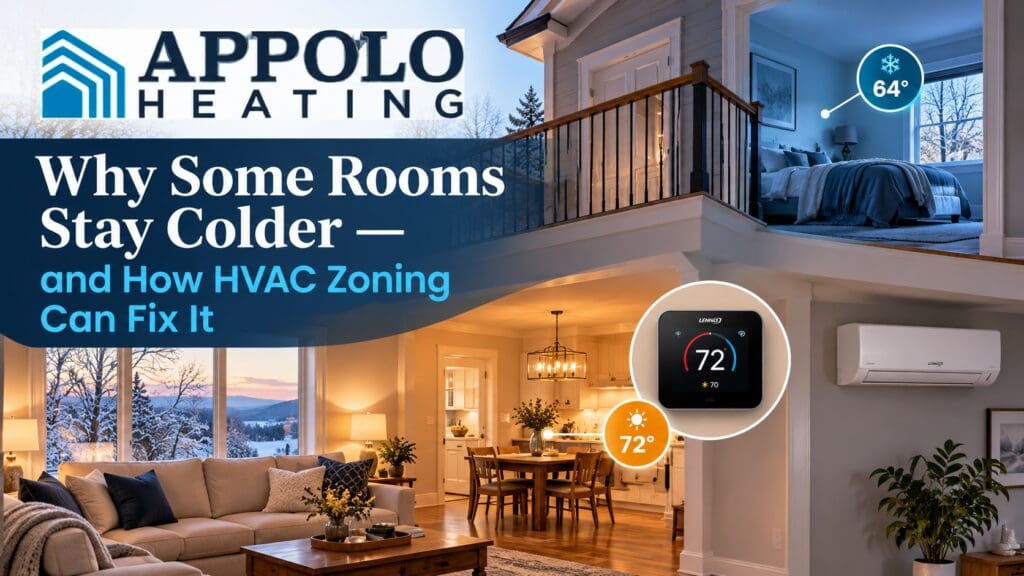
Every Upstate New York homeowner seems to know that room.
The upstairs bedroom that’s comfortable until January. The family room over the garage where everyone keeps a blanket nearby. The addition that never quite warms up. Or the first-floor thermostat that says 70°F while a bedroom at the other end of the house feels nowhere close.
Turning up the thermostat may warm that room eventually.
It also usually overheats the rest of the house.
The problem isn’t necessarily that your furnace or heat pump isn’t powerful enough. More often, different parts of the home have different heating needs, while a traditional HVAC system is trying to treat the entire house as one space.
That’s where HVAC zoning can make a real difference.
But before adding controls and dampers, it’s important to understand why the room is cold in the first place.
Why Is One Room Colder Than the Rest of the House?
Uneven heating usually comes down to one or more of these issues.
1. The Room Loses Heat Faster
A corner bedroom with two exterior walls behaves differently from an interior bedroom.
Add large windows, a cathedral ceiling or a location above an unheated garage, and the difference gets even greater.
During an Upstate New York winter, those factors matter. ENERGY STAR specifically identifies insufficient insulation and air leakage in attics, basements and crawlspaces as common causes of rooms that remain hotter or colder than the rest of the house. ENERGY STAR
The room may simply be losing heat faster than the HVAC system is delivering it.
2. Not Enough Heated Air Is Reaching the Room
In a forced-air system, every room depends on the ductwork delivering the right amount of air.
Long duct runs, undersized ducts, crushed flexible duct, poorly balanced registers and leakage can all reduce the amount of heat reaching a distant room.
And duct leakage is more significant than many homeowners realize. ENERGY STAR estimates that 20% to 30% of the air moving through a typical home’s duct system can be lost through leaks, holes and poor connections. Difficult-to-heat rooms are one of the common symptoms. ENERGY STAR
Turning the thermostat higher doesn’t repair a leaking duct.
It simply tells the equipment to run longer.
3. The Thermostat Is Measuring the Wrong Part of the House
A conventional HVAC system usually responds to one thermostat.
Imagine that thermostat is in a centrally located downstairs hallway. It reaches 70°F and tells the furnace to stop.
Meanwhile, the bedroom over the garage may still be 65°F.
As far as the furnace knows, its job is finished.
This is one of the fundamental limitations that zoning addresses: one thermostat cannot accurately represent several areas with very different heating loads.
4. The Home Was Changed but the HVAC System Wasn’t
Additions, finished basements, converted attics and bonus rooms are common trouble spots.
The original heating system may have been designed years before those spaces became part of the conditioned home.
ENERGY STAR specifically identifies additions, spaces over garages, home offices and existing hot or cold spots as strong applications for supplemental or ductless heating and cooling. ENERGY STAR
Sometimes extending the existing ductwork works.
Sometimes giving the space its own zone is the much better answer.
5. Sun Exposure and Home Layout Create Different Loads
The north side of an Upstate New York home may receive little winter sunlight while south-facing rooms warm naturally during the day.
Large windows matter. So do vaulted ceilings, open staircases and multiple floors.
Lennox specifically identifies homes with upper floors that run warmer or colder, large windows and different room-by-room comfort needs as candidates for zoning. Lennox
The house isn’t experiencing one heating load.
It’s experiencing several.
What Does HVAC Zoning Actually Do?
A true HVAC zoning system divides the home into separate comfort areas.
In a traditional ducted system, motorized dampers inside the ductwork open and close based on which zone needs heating or cooling.
Instead of every room receiving conditioned air whenever one thermostat calls, the system can direct airflow toward the areas that actually need it.
For example:
Zone 1: First-floor living spaces
Zone 2: Second-floor bedrooms
Zone 3: Primary suite
Zone 4: Addition or bonus room
When the upstairs calls for heat, the system can prioritize that zone without continuing to heat a first floor that’s already comfortable.
Lennox’s current zoning systems can control as many as four zones, depending on the equipment configuration. Lennox
A Room Sensor Isn’t the Same Thing
This distinction is important.
Adding a remote temperature sensor can help your thermostat understand temperatures elsewhere in the house, but it doesn’t necessarily control where the air goes.
Lennox specifically notes that its Smart Room Sensors are not a substitute for zoning and cannot correct problems caused by poor ductwork or incorrect equipment sizing. True zoning redirects airflow into the areas requiring conditioning. Lennox
That’s why diagnosing the underlying comfort problem comes first.
When Zoning Works Especially Well in Upstate New York
Zoning tends to make the most sense when different sections of a home have predictably different heating and cooling requirements.
Good candidates include:
- Multi-story homes
- Bedrooms over garages
- Finished basements
- Finished attics
- Large additions
- Rooms with extensive glass
- Vaulted-ceiling spaces
- Homes with seldom-used sections
- Families that prefer different bedroom temperatures
- Homes where upstairs and downstairs temperatures differ substantially
It’s particularly useful in our climate because the same room can behave differently by season.
That west-facing upstairs bedroom that’s difficult to heat in January may become the hottest room in the house in July.
A properly designed zoning solution addresses both.
What Zoning Won’t Fix
This may be the most important part of the conversation.
Zoning isn’t a substitute for fixing a building problem.
If a room is cold because its attic insulation is inadequate, the answer may be insulation.
If a duct has separated in the attic, the answer is repairing the duct.
If the furnace is significantly undersized, zoning can’t manufacture additional heating capacity.
If airflow is already poor, simply installing dampers without redesigning how the system handles airflow can create new problems.
ENERGY STAR specifically recommends evaluating insulation, air leakage and duct performance when homeowners experience uneven room temperatures. ENERGY STAR
That’s why Appolo starts with the house.
Before recommending zoning, we need to understand:
- The home’s heating and cooling load
- Existing duct design
- Airflow to each problem area
- Insulation and air leakage
- Equipment capacity
- How the homeowner actually uses each space
Sometimes zoning is the answer.
Sometimes fixing the ductwork is.
Sometimes it’s both.
The Lennox Zoning Systems We Like for Upstate New York Homes
As a Lennox Premier Dealer serving the Capital Region, Southern Tier and Hudson Valley, Appolo has several approaches available depending on the home and existing equipment. Appolo has served New York since 1968 and installs and services Lennox heating, heat-pump and ductless equipment throughout all three regions. Appolo Heating
There isn’t one “best” zoning system for every house. These are the Lennox options we would most often evaluate.
Lennox Smart Zoning: The Premium Whole-Home Approach
For homeowners pairing zoning with compatible premium Lennox equipment, the Lennox Smart Zoning System, also known as iHarmony®, is the most integrated solution.
It can create up to four zones and works with compatible Lennox communicating equipment to direct conditioned air where it’s needed. Lennox
This is especially compelling when replacing older equipment and redesigning the home’s comfort system as a whole.
Rather than simply asking the furnace or heat pump to turn on or off, a communicating, variable-capacity system can adjust operation more closely to actual demand.
For a large two-story Capital Region home where the upstairs runs cold all winter and hot all summer, this is the type of solution Appolo would evaluate.
Lennox LZP-4: Strong for Multi-Stage and Dual-Fuel Systems
The Lennox LZP-4 divides a home into as many as four zones and is designed to integrate with multi-stage equipment.
It is also compatible with dual-fuel configurations that combine a heat pump and furnace. Lennox
That’s particularly relevant in Upstate New York.
A homeowner can potentially combine zone control with a heat pump for efficient heating during much of the season and a furnace for additional capacity when conditions call for it.
Lennox MMLD Multi-Zone: When Ductwork Isn’t the Answer
Sometimes the best zoning system doesn’t use the home’s existing ducts at all.
The Lennox MMLD Multi-Zone cold-climate mini-split heat pump can connect one outdoor system with as many as five indoor comfort zones.
Each area can receive its own heating and cooling rather than depending on air traveling from another part of the house. Lennox
For our climate, its cold-weather performance is especially relevant: Lennox rates the MMLD to maintain 100% heating capacity at 5°F and operate at outdoor temperatures as low as -13°F. Lennox
This can be an excellent approach for:
- Older homes with boilers or radiators
- Finished additions
- Attics
- Bedrooms over garages
- Homes where extending ductwork would be disruptive
- Several isolated comfort problem areas
NYSERDA recognizes zoned heat pumps as a viable New York solution and has documented homes—including an older Ithaca home—using combinations of ducted and ductless zones successfully through severe New York winter conditions. NYSERDA
Lennox MWLD: When It’s Really Just One Problem Room
If the rest of the house is comfortable and there is truly only one difficult space, installing an elaborate whole-home zoning system may be unnecessary.
The Lennox MWLD single-zone cold-climate mini-split is designed specifically for one zone.
Lennox rates it up to 25 SEER2 and 11 HSPF2, with full heating capacity at 5°F and operation down to -22°F. Lennox
That makes it worth considering for a stubborn bonus room, home office or addition where the existing system simply can’t deliver enough comfort.
Why Variable-Capacity Equipment and Zoning Work Well Together
There’s a reason premium zoning is often paired with variable-capacity equipment.
Imagine only one small bedroom zone is calling for heat.
A traditional furnace designed to heat the entire house may produce far more airflow than that one zone needs.
Variable-capacity equipment can adjust output more closely to the actual demand—more like a dimmer switch than a simple on/off switch.
The result can be:
- More consistent temperatures
- Longer, gentler heating cycles
- Better airflow control
- Less dramatic temperature swing
- Lower unnecessary energy use
- Better compatibility with multiple zones
This becomes particularly valuable in Upstate New York, where heating demand may range from a mild 45°F fall afternoon to a single-digit January night.
Should You Close Vents in Cold or Unused Rooms Instead?
Not as a substitute for proper zoning.
Manually closing a few registers may seem like a DIY zoning system, but a forced-air HVAC system is designed around specific airflow requirements.
A professionally designed zoning system coordinates thermostats, dampers and HVAC equipment rather than randomly restricting airflow.
If you’re trying to solve uneven temperatures by continually opening and closing registers, that’s a good sign it’s worth having the system evaluated.
Could Duct Sealing Solve the Problem Before You Add Zoning?
Absolutely.
If a room gets less conditioned air because ducts are leaking into an attic, garage or basement, recovering that lost airflow may significantly improve comfort.
ENERGY STAR notes that duct leakage can contribute directly to difficult-to-heat rooms, higher heating bills and systems that can’t maintain comfortable temperatures regardless of thermostat setting. ENERGY STAR
Appolo evaluates ductwork during system design and can address duct sealing and modification where needed. Appolo Heating
The best zoning project often begins with making sure the air you already paid to heat is actually reaching the house.
The Right Solution Starts With the Room — Not the Equipment
If one bedroom is always five degrees colder than the hallway, you shouldn’t have to choose between freezing in that room and overheating the rest of the house.
But installing equipment before understanding why that room is cold is backwards.
The right sequence is:
Diagnose the heat loss → evaluate airflow → inspect the ductwork → calculate the load → then determine whether zoning makes sense.
That might lead to duct repairs.
It might lead to whole-home Lennox zoning.
It might lead to one cold-climate mini-split.
Or it might uncover an insulation problem that needs to be addressed alongside the HVAC work.
That’s how Appolo approaches comfort problems throughout the Capital Region, Southern Tier and Hudson Valley.
We’re a Lennox Premier Dealer, but the goal isn’t to fit your home around a particular piece of equipment.
It’s to determine which Lennox solution—or which repair to the system you already own—actually solves the problem.
Have a room that’s always colder than the rest of the house? Schedule a comfort consultation with Appolo Heating and let us find out why.
Explore Appolo Heating Services
Learn About Appolo’s Ductless Solutions
Frequently Asked Questions About HVAC Zoning
Why is one bedroom colder than the rest of my house?
Common causes include insufficient airflow, duct leakage, inadequate insulation, air leaks, greater exterior exposure, large windows or the room being farther from the furnace. A thermostat located elsewhere in the house can also stop the heating cycle before that bedroom reaches the desired temperature. ENERGY STAR
What is an HVAC zoning system?
A zoning system divides a home into separate areas that can call for heating or cooling independently. In a forced-air system, thermostats and motorized duct dampers work together to direct conditioned air toward the zones that need it.
Can HVAC zoning make one room warmer?
Yes, when inadequate temperature control—not insufficient total heating capacity or a serious building-envelope problem—is causing the imbalance. A zoned system can direct more heating toward an area that hasn’t yet reached its temperature setting.
How many zones can a Lennox zoning system have?
Current Lennox Smart Zoning and LZP-4 systems support up to four zones. Lennox’s MMLD multi-zone mini-split can support up to five indoor comfort zones from one outdoor unit. Lennox
Is a smart thermostat the same as HVAC zoning?
No. A thermostat or room sensor can measure temperature elsewhere in the house, but true zoning controls where conditioned air is delivered. Lennox specifically distinguishes its Smart Room Sensors from its zoning products. Lennox
Is ductless considered zoning?
It can be. A multi-zone ductless system gives individual areas their own indoor units and temperature control. That makes ductless especially useful in older New York homes without conventional ductwork or in additions and isolated problem rooms. ENERGY STAR
Can HVAC zoning work with a furnace and heat pump?
Yes. Lennox’s LZP-4 zoning system is specifically compatible with dual-fuel systems combining a furnace and heat pump. Lennox
Will zoning lower my heating bills?
It can reduce wasted heating and cooling by allowing the system to condition occupied areas differently from spaces that need less conditioning. Actual savings depend on the home, equipment, ductwork, thermostat settings and how the zones are used. Lennox identifies reduced conditioning of unused areas as one of the efficiency advantages of its zoning systems. Lennox
Do cold-climate mini-splits work during an Upstate New York winter?
Properly selected cold-climate equipment can. For example, Lennox rates its MWLD single-zone model for operation down to -22°F and its MMLD multi-zone model down to -13°F. System sizing and home heat loss still matter significantly. Lennox
Is Appolo Heating a Lennox Premier Dealer?
Yes. Appolo is a Lennox Premier Dealer serving New York’s Capital Region, Southern Tier and Hudson Valley, with heating, heat-pump and ductless installation and service across those regions.