
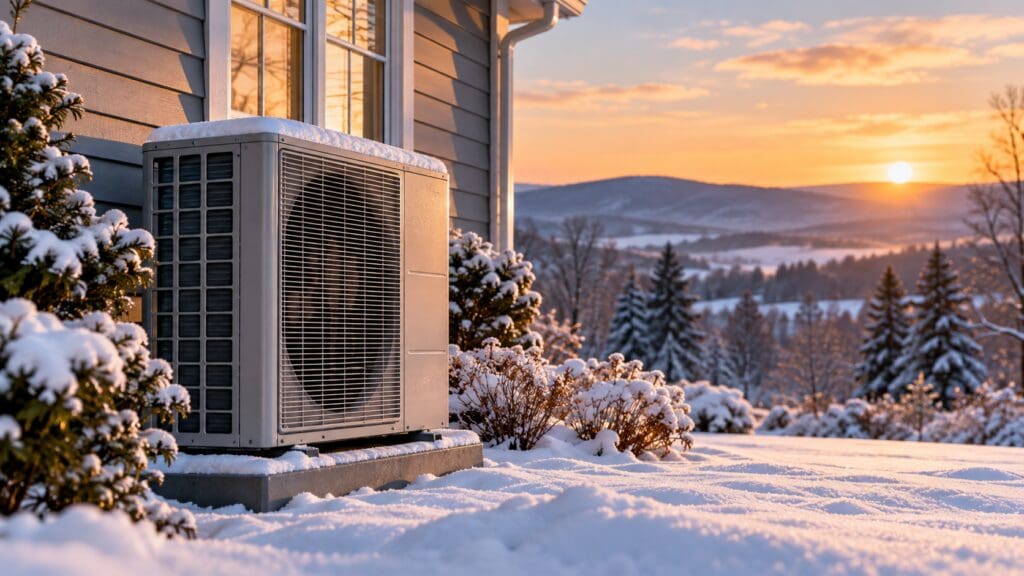
Do Heat Pumps Work in Upstate New York Winters? What Homeowners Should Know
If you grew up in Upstate New York, you may have heard some version of this advice:
“Heat pumps are fine down South, but they don’t work in a New York winter.”
That may have been a reasonable concern with older heat-pump technology. It isn’t an accurate description of today’s cold-climate heat pumps.
Modern systems are specifically designed to continue producing heat at temperatures well below freezing. ENERGY STAR’s cold-climate designation requires qualifying systems to demonstrate low-temperature performance at 5°F, including retaining at least 70% of their rated 47°F heating capacity. ENERGY STAR
So, yes: a properly selected, sized and installed cold-climate heat pump can work very well through an Upstate New York winter.
But there is more to the story than simply buying a unit labeled “heat pump.”
Here is what homeowners throughout the Capital Region, Hudson Valley and Southern Tier should understand before making the switch.
How Does a Heat Pump Work When It’s Cold Outside?
A heat pump does not create heat the way a furnace does.
Instead, it transfers heat.
During the summer, it works much like a traditional central air conditioner by moving heat from inside your home to the outdoors.
During the winter, that process reverses. The heat pump extracts available heat from the outdoor air and transfers it into your home.
That often leads to the obvious question:
How can it pull heat out of the air when it’s 10°F outside?
Because cold air still contains thermal energy. Modern variable-speed compressors, refrigerants and system controls allow cold-climate heat pumps to capture that energy at temperatures where older generations of equipment struggled.
NYSERDA says properly sized cold-climate air-source heat pumps can provide heating through New York winters and notes that some models have been tested to produce heat at outdoor temperatures as low as -30°F. NYSERDA
That doesn’t mean every heat pump performs the same at -10°F as it does at 40°F. It means the right equipment can continue doing its job when the temperature drops.
What Happens to Heat Pump Efficiency as Temperatures Fall?
This is the part of the conversation that matters in Upstate New York.
As outdoor temperatures fall, a heat pump generally has to work harder to move enough heat into your home. Heating capacity and efficiency can decline as the difference between the outdoor and indoor temperatures becomes greater.
That is normal.
Cold-climate equipment is engineered specifically to improve performance under those conditions. Under ENERGY STAR’s current cold-climate criteria, qualifying split systems must achieve a coefficient of performance of at least 1.75 at 5°F. ENERGY STAR
In plain English, that means the system is still moving significantly more heat energy than the electrical energy it consumes under the standardized 5°F test condition.
NYSERDA’s field research has also found that properly designed and sized cold-climate air-source heat pumps can provide adequate heating, cooling and comfort in New York within expected efficiency ranges. NYSERDA
The takeaway isn’t that outdoor temperature no longer matters.
It’s that cold weather by itself is no longer a reason to rule out a heat pump.
The Bigger Issue in Upstate New York: Proper Sizing
If you’re considering a heat pump for a New York home, equipment selection is only half the job.
Sizing matters enormously.
A contractor needs to understand how much heat your house actually loses on a cold winter day.
That depends on things like:
- Square footage
- Insulation levels
- Window size and quality
- Air leakage
- Ceiling height
- Home orientation
- Ductwork condition
- Number of exterior walls
- Local winter design temperatures
- How different areas of the home are used
Installing a heat pump based primarily on square footage can lead to trouble.
An undersized system may struggle to maintain the desired indoor temperature during the coldest weather. An oversized system can short-cycle and create comfort or efficiency problems.
Appolo uses load calculations when designing heat-pump systems because the goal isn’t simply to install equipment that works in October.
It needs to be designed for January in Upstate New York.
You can learn more about Appolo’s available [heating solutions, including heat pumps, furnaces and boilers]Heating Systems from Appolo Heating.
Does a Heat Pump Need Backup Heat in Upstate New York?
Sometimes.
And that isn’t a failure of the technology.
There are several ways a heat-pump system can be designed for a cold climate.
A Whole-Home Cold-Climate Heat Pump
Some homes can be designed around a cold-climate heat pump as the primary heating source.
The equipment must be selected and sized to meet the home’s heating load at the expected winter design temperature.
A Heat Pump With Supplemental Electric Heat
Some systems use electric resistance backup during periods when additional heating capacity is needed.
A Dual-Fuel System
For many Upstate New York homeowners, this is an especially interesting option.
A dual-fuel system combines a heat pump with a furnace or, in some configurations, retains another heating system as backup.
The heat pump can handle much of the heating season. When outdoor conditions reach a predetermined point, the system can transition to the backup heat source.
Appolo installs dual-fuel heat-pump configurations as part of its cold-climate heat-pump offering. Appolo Heating
This can be attractive for homeowners who want the heating and cooling benefits of a heat pump without completely giving up an existing furnace.
There is no universal “switch-over temperature” that’s right for every house. It depends on the equipment, energy costs, system design and the home’s heating load.
Will a Heat Pump Feel Different From a Furnace?
Usually, yes.
And that doesn’t mean something is wrong.
A furnace typically produces very hot supply air for shorter periods.
A heat pump often delivers warmer-than-room-temperature air over longer cycles.
The result can actually be very consistent indoor temperatures, but homeowners accustomed to the blast of hot air from a furnace may notice the difference at first.
Modern variable-capacity heat pumps are designed to adjust output instead of continually cycling between full power and off.
That’s one reason thermostat habits can also be different.
NYSERDA recommends allowing heat pumps to maintain a relatively consistent thermostat setting rather than making frequent large temperature setbacks. NYSERDA
In other words, with a heat pump, steady and comfortable usually beats constantly turning the thermostat up and down.
What About Snow and Ice?
A heat pump’s outdoor unit needs to remain exposed to outdoor air, so winter conditions matter.
During normal heating operation, frost can develop on the outdoor coil. Heat pumps automatically enter a defrost cycle periodically to remove that frost.
Seeing some steam or hearing the system change operating sounds during defrost can be completely normal.
Homeowners can help by keeping the outdoor unit clear of excessive snow, leaves and other debris.
Do not pile shoveled snow against the unit, and don’t try to chip ice off the coils with tools.
If the unit becomes heavily iced over and does not appear to be clearing itself through normal defrost operation, that’s a reason to have the system inspected.
Do Heat Pumps Need Winter Maintenance?
Yes.
A heat pump works year-round, which means it can accumulate a lot of operating hours.
Before the heating season, professional maintenance can help verify that components affecting winter performance are operating correctly.
Depending on the system, that can include checking:
- Filters and airflow
- Electrical connections
- Motors and amperage
- Refrigerant operation
- Thermostat calibration
- Outdoor coil condition
- Condensate drainage
- Temperature performance
- Safety controls
- Backup or auxiliary heat operation
Appolo’s seasonal HVAC tune-ups follow a multi-point inspection process covering airflow, electrical components, motors, temperature performance, thermostat calibration and other critical system functions. Appolo Heating
If you depend on a heat pump during an Upstate New York winter, you don’t want to discover an airflow problem, weak electrical component or backup-heat issue on the first single-digit night.
Are Heat Pumps a Good Fit for Older Upstate New York Homes?
They can be.
In fact, some of the housing characteristics common throughout our region can make heat pumps especially useful.
Older homes may have:
- Boiler or radiator heat
- No central air conditioning
- Additions without ductwork
- Finished attics
- Converted basements
- Rooms that are consistently too hot or too cold
Ductless heat pumps can provide targeted heating and cooling without requiring a full traditional duct system.
For homes that already have ducts, a centrally ducted heat pump may be an option.
And for homeowners who want to keep an existing furnace, a dual-fuel configuration can combine newer heat-pump technology with familiar backup heat.
The right solution depends much more on the house than on its age.
Can a Heat Pump Replace Both My Furnace and Air Conditioner?
Potentially, yes.
A heat pump provides both heating and cooling, so replacing an aging air conditioner can be a logical time to evaluate whether a heat pump makes sense.
Appolo’s heating lineup includes heat pumps alongside furnaces, boilers, radiant heating and ductless systems, allowing the system recommendation to be based on the home’s needs rather than trying to force one technology into every application. Appolo Heating
For some homeowners, a heat pump can become the primary heating and cooling system.
For others, pairing a heat pump with a furnace makes more sense.
And in some homes, staying with a traditional furnace or boiler may still be the right answer.
So, Do Heat Pumps Really Work in Upstate New York?
Yes. Modern cold-climate heat pumps can work effectively through Upstate New York winters when the system is properly selected, sized and installed.
That’s the important qualification.
The question shouldn’t simply be:
“Can a heat pump work here?”
The better questions are:
- Is this model designed for cold climates?
- What is its heating capacity at low outdoor temperatures?
- Has the home’s heating load been calculated?
- Does the system need backup heat?
- Is the existing ductwork appropriate?
- How will the system perform during the coldest conditions in this particular location?
When those questions are answered correctly, cold-climate heat pumps can be a practical heating option even in a part of the country where winter temperatures routinely drop below freezing.
Get Your Heating System Ready Before Winter
Whether your home is heated by a heat pump, furnace or boiler, fall is the time to make sure the system is ready.
Appolo Heating serves homeowners throughout the Capital Region, Hudson Valley and Southern Tier, with heating repair, maintenance and installation for heat pumps and other residential heating systems. Appolo has served New York homeowners since 1968 and is a Lennox Premier Dealer. Appolo Heating
Cold weather always shows up.
The only question is whether your heating system is ready when it does.
Schedule heating maintenance before the schedule fills.
Frequently Asked Questions About Heat Pumps in Upstate New York
Do heat pumps work below freezing?
Yes. Cold-climate heat pumps are specifically engineered to operate below freezing. ENERGY STAR’s cold-climate designation requires qualifying equipment to demonstrate heating performance at 5°F, and systems can continue operating below that temperature. ENERGY STAR
How cold is too cold for a heat pump?
There is no single cutoff temperature that applies to every heat pump. Each model has its own low-temperature operating limits and heating-capacity characteristics. Some cold-climate models have been tested to provide heat at temperatures down to -30°F, according to NYSERDA. NYSERDA
Will a heat pump keep my house warm at 0°F?
A properly designed cold-climate system can provide heat at 0°F and below. Whether it can meet your home’s entire heating load at that temperature depends on equipment capacity, sizing and the home’s heat loss.
Do I still need a furnace if I install a heat pump in Upstate New York?
Not necessarily. Some homes can use a cold-climate heat pump as their primary heating system. Other homeowners choose a dual-fuel setup that combines the heat pump with a furnace for additional capacity during extremely cold conditions.
Is a cold-climate heat pump different from a regular heat pump?
Yes. Cold-climate models are designed and tested for stronger heating performance at low outdoor temperatures. ENERGY STAR applies additional low-temperature capacity and efficiency requirements to equipment carrying its cold-climate designation. ENERGY STAR
Are heat pumps efficient in New York winters?
They can be. Efficiency generally decreases as temperatures fall, but cold-climate equipment is designed to continue transferring heat efficiently at low temperatures. NYSERDA’s New York field research found properly designed cold-climate systems delivered expected heating performance and comfort. NYSERDA
Should I turn my heat pump off when temperatures drop below zero?
Generally, no. NYSERDA recommends continuing to operate a properly designed heat pump in very cold weather rather than shutting it off simply because outdoor temperatures drop below zero. NYSERDA
How often should a heat pump be serviced?
Because heat pumps provide both heating and cooling, seasonal professional maintenance is important. Appolo recommends seasonal HVAC tune-ups that inspect airflow, electrical components, motors, thermostat performance and other system functions. Appolo Heating
Can a heat pump also cool my house in summer?
Yes. A heat pump essentially reverses its refrigeration cycle between seasons, providing heating in winter and air conditioning in summer.
What type of heat pump is best for Upstate New York?
Look for a cold-climate heat pump with published low-temperature performance appropriate for your home’s location and heating load. The best system also depends on whether the home has ductwork, the condition of that ductwork, insulation and whether you want supplemental or dual-fuel heat.
When should I schedule heat-pump maintenance for winter?
Early fall is ideal, before the heating season is in full swing and HVAC appointment schedules become busier.
Schedule heating maintenance before the schedule fills.