
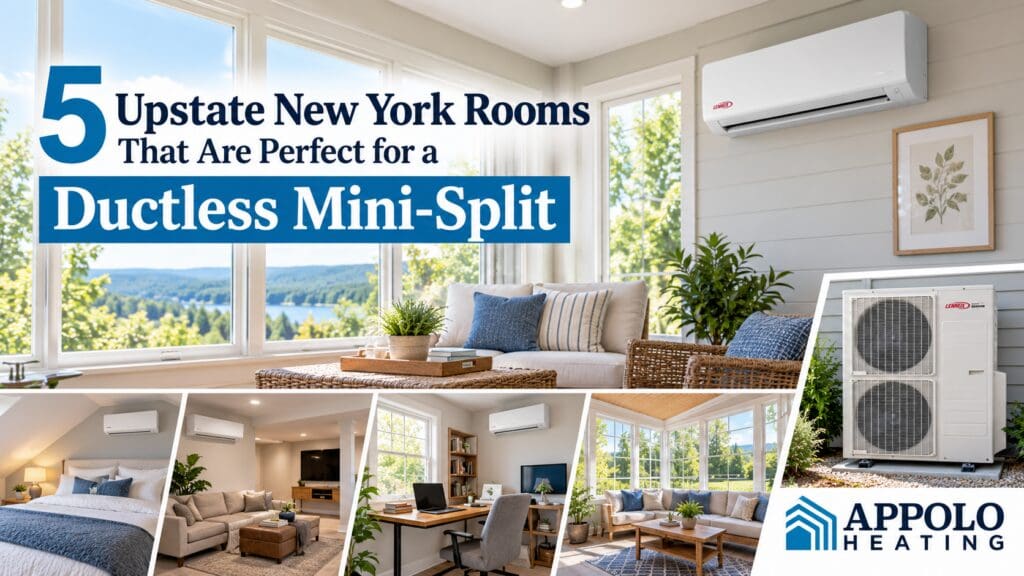
Upstate New York Rooms That Are Perfect for a Ductless Mini-Split
Every Upstate New York home seems to have one.
The sunroom that’s great in May but unbearable in July. The bedroom over the garage that’s freezing all winter. The finished basement everyone wants to use—until they actually spend an evening down there.
You can sometimes solve these problems by modifying the home’s existing heating and cooling system. But extending ductwork into a room that was never designed for it can get complicated quickly.
That’s where a ductless mini-split can make a lot of sense.
Instead of trying to make your entire furnace or central air-conditioning system work harder for one problem area, a ductless system gives that room or zone its own heating and cooling. ENERGY STAR specifically identifies additions, above-garage rooms, home offices, older homes without ducts and persistent hot or cold spots as strong applications for mini-split heat pumps.
For Upstate New York homeowners, the key is choosing equipment that’s designed for our climate and properly sizing it for the space.
Here are five rooms where we see ductless make particularly good sense.
1. The Sunroom or Three-Season Room You Want to Use All Year
Sunrooms are almost designed to create heating and cooling problems.
All that glass that makes the room beautiful in October can let in a tremendous amount of heat during the summer. Come winter, those same windows can make the room lose heat much faster than the rest of the house.
And because many sunrooms and enclosed porches were added after the original home was built, they often aren’t connected to the home’s ductwork at all.
A ductless mini-split changes that.
You get dedicated heating and cooling for the sunroom without extending your central duct system. Because the system responds to conditions in that room—not the thermostat sitting in your hallway—the space can stay comfortable without overheating or overcooling the rest of the house.
For a heavily used four-season room, a cold-climate single-zone system such as the Lennox MWLD is worth discussing. The MWLD is a variable-capacity, ENERGY STAR-qualified cold-climate mini-split rated up to 25 SEER2 and 11 HSPF2. Lennox states that it can maintain full heating capacity at 5°F and continue operating at temperatures as low as -22°F.
That kind of low-temperature capability matters a lot more here than it does in a warmer part of the country.
2. The Bedroom or Bonus Room Above the Garage
If there’s one room in the house that never seems to agree with the thermostat, it’s often the room above the garage.
During winter, you have an unheated space underneath the floor. During summer, the room may be taking heat through the roof and exterior walls. And if it’s at the far end of the home’s duct system, airflow may already be weaker by the time it gets there.
The result?
Too cold in January. Too hot in July. Never quite right.
Rather than trying to force additional airflow through an existing system, a mini-split lets us treat that room as its own comfort zone.
A single-zone Lennox system can heat or cool based on what the upstairs room actually needs. Variable-capacity operation is particularly useful here because the system doesn’t simply run at full power and shut off. It can adjust output as the room approaches the desired temperature.
Indoor-unit placement can also be more flexible than many homeowners realize. Lennox currently offers traditional wall-mounted units, floor consoles and ceiling-cassette configurations, giving us options when sloped ceilings or limited wall space make a conventional wall head less attractive.
For an attic conversion or bonus room with knee walls, for example, a Lennox MFMD floor-mounted console may be worth considering instead of automatically placing a unit high on the wall.
3. The Finished Basement or In-Law Suite
You’ve finished the basement.
There’s a television, maybe a sectional, an office or even a guest bedroom.
There’s just one problem: nobody wants to spend much time down there.
Basements behave differently from the main living space. They tend to stay naturally cooler, may have different moisture conditions and frequently weren’t part of the home’s original HVAC design.
Adding a few supply registers isn’t always enough to fix that.
A ductless mini-split gives the basement independent temperature control, so you’re not changing the thermostat for the entire house just to make the downstairs family room comfortable.
That’s especially useful when a basement has become an in-law suite, guest area, playroom or home theater that gets used at very different times from the rest of the house.
Depending on layout, a wall-mounted Lennox MWMD or a lower-mounted console can give you heating and cooling without building out a separate duct system. The MWMD is a high-efficiency single-zone indoor unit that includes features such as occupancy sensing and remote control through the SmartThings platform.
And because mini-splits provide cooling as well as heating, you’re solving the July problem at the same time as the January problem.
4. The Home Office, Converted Garage or Workshop
Working from home changes the economics of comfort.
If you spend eight hours every weekday in a room that used to be an occasional guest bedroom, suddenly that room’s temperature matters quite a bit.
The same applies to a converted garage, hobby room or workshop.
Running your entire central HVAC system to condition one occupied room isn’t always the most practical solution. A ductless mini-split lets that space operate independently.
Set the office where you’re comfortable during the day. Let the rest of the house follow its normal schedule.
For these rooms, quiet operation matters too. You don’t want the heating and cooling system becoming the loudest person on your Zoom call.
Modern ductless systems use variable-capacity operation rather than constantly cycling between full output and off. Lennox’s current ductless lineup also includes wall-mounted units designed to distribute conditioned air gently rather than delivering a hard blast of hot or cold air.
And if the office isn’t occupied every day, features such as motion detection and app-based controls can help the room operate around the way you actually use it.
5. That One Bedroom or Addition Your Central System Can’t Fix
Sometimes there’s nothing unusual about the room.
It’s simply uncomfortable.
Maybe it’s the bedroom at the end of the second-floor hallway. Maybe it’s an addition built twenty years after the original house. Maybe it’s the corner room with three exterior walls.
You have the thermostat set to 70°F, but somehow that room seems to have its own opinion.
Those persistent hot and cold spots are exactly where ductless zoning can shine.
And if you have more than one problem room, that doesn’t necessarily mean installing several completely independent systems.
A multi-zone system can connect several indoor units to one outdoor heat pump while still allowing individual rooms to have their own comfort settings.
The Lennox MMLD multi-zone cold-climate mini-split, for example, can support up to five indoor comfort zones. Lennox rates the system to maintain full heating capacity at 5°F and operate down to -13°F, making it particularly relevant when designing a multi-room solution for our region.
That can make sense for a home where the upstairs bedrooms, addition and finished basement all have different comfort needs.
Why Ductless Works So Well in Upstate New York Homes
A lot of the homes throughout the Capital Region, Hudson Valley and Southern Tier were built long before central air conditioning was standard.
Boiler heat, radiators and baseboards are common. So are additions that were built years after the original heating system was installed.
Ductless gives us another option.
Instead of opening walls and building an entirely new duct system, a mini-split uses an outdoor heat-pump unit connected to one or more indoor units. That allows homeowners to add heating and cooling exactly where it’s needed.
NYSERDA notes that ductless mini-splits provide individual room temperature control, don’t require existing ductwork and can be less invasive than adding a traditional duct distribution system. NYSERDA also specifically recommends looking for cold-climate models appropriate for New York weather.
That last part is important.
Not Every Mini-Split Is the Right Mini-Split for Upstate New York
Buying a mini-split based on square footage alone is a mistake.
A 400-square-foot sunroom with walls full of glass behaves very differently from a 400-square-foot basement. The same is true for an insulated interior office versus a room sitting above an unheated garage.
Equipment selection needs to account for:
- Room size and ceiling height
- Number and type of windows
- Insulation levels
- Exterior-wall exposure
- Sun exposure
- How the room is used
- Desired heating performance during winter
- Existing heating equipment
- Location of the indoor and outdoor units
ENERGY STAR recommends that contractors use a proper Manual J load calculation rather than simply guessing at equipment capacity. Oversized and undersized systems can both compromise comfort and performance.
That’s why Appolo looks at the room first and the equipment second.
Which Lennox Mini-Split Is Right for Your Home?
There isn’t one Lennox mini-split we recommend for every application.
A sunroom needing dependable winter heat may point us toward a cold-climate single-zone configuration such as the MWLD.
A home office may pair well with the MWMD wall-mounted indoor unit, especially when independent control and quiet operation are priorities.
If several rooms need individual control, the MMLD multi-zone system can support multiple indoor zones from one outdoor unit. Lennox also offers ceiling cassette, floor-mounted and ducted mini-split indoor options for spaces where a standard wall-mounted unit isn’t the best fit.
The right answer depends on the home.
And that’s really the advantage of ductless: we don’t have to force every room into the same HVAC solution.
Can a Mini-Split Really Heat During an Upstate New York Winter?
Yes—but equipment selection matters.
Cold-climate heat-pump technology has improved considerably. ENERGY STAR now has specific cold-climate performance requirements, including verified testing at 5°F, and recommends cold-climate equipment for regions where winter temperatures regularly fall below freezing.
NYSERDA’s research into cold-climate air-source heat pumps in New York has also found that properly designed and sized systems can provide adequate heating, cooling and comfort within expected performance ranges.
That doesn’t mean every house should abandon its furnace or boiler.
In many Upstate New York homes, ductless works extremely well as a targeted comfort solution alongside an existing heating system. In others, a properly designed multi-zone cold-climate system may take on a much larger share of the home’s heating and cooling.
The important part is designing the system around the house instead of expecting the house to adapt to the equipment.
A Mini-Split Might Be the Simplest Fix for Your Most Difficult Room
You don’t always need to replace your entire HVAC system to solve one uncomfortable room.
Sometimes the better answer is to give that room its own system.
If you have a sunroom you avoid half the year, an upstairs bedroom that’s always uncomfortable, a finished basement that never feels finished, or a home office where the space heater has become permanent furniture, it’s worth taking a look at ductless.
Appolo Heating installs and services single- and multi-zone ductless systems throughout the Capital Region, Southern Tier and Hudson Valley, and we’re a Lennox Premier Dealer.
We’ll look at the space, calculate what it actually needs and help you determine whether a Lennox ductless mini-split makes sense—or whether there’s a better solution.
Have a room that’s always too hot or too cold? Schedule a ductless consultation with Appolo Heating and let us take a look.
Frequently Asked Questions About Ductless Mini-Splits
Can I install a mini-split in just one room?
Yes. Single-zone ductless systems are specifically designed to heat and cool one room or defined area independently.
Can one mini-split handle several rooms?
Sometimes, but airflow doesn’t travel well through closed doors. For several separate rooms, a multi-zone system with individual indoor units is usually a better approach. ENERGY STAR specifically notes that room layout and airflow need to be considered when planning indoor-unit placement.
Do ductless mini-splits provide both heat and air conditioning?
Heat-pump mini-splits do. They move heat into the home during heating season and reverse operation to move heat outdoors during cooling season.
Are mini-splits good for homes with boiler or radiator heat?
They can be an excellent option because they don’t require a traditional forced-air duct system. ENERGY STAR specifically identifies older homes with radiator or baseboard heat as a common application for ductless systems.
Do I need a cold-climate mini-split in Upstate New York?
For equipment expected to provide meaningful winter heating, cold-weather performance should absolutely be part of the conversation. The specific system depends on the home’s heating load, existing equipment and how you intend to use the mini-split.
Are rebates available for ductless mini-splits in New York?
They may be. Appolo notes that qualifying cold-climate ductless heat pumps can be eligible for NYS Clean Heat utility incentives, with eligibility depending on the equipment and installation.
Why use a Lennox Premier Dealer?
Appolo is a Lennox Premier Dealer and installs and services Lennox heating, heat-pump and ductless equipment. That gives us access to Lennox system options while still allowing the recommendation to start with your home’s actual comfort needs—not simply a model number.